AI for Public Good
Responsible Artificial Intelligence that helps governments, researchers, and development organizations turn public data into actionable insights for better governance and inclusive development across India.
3
AI Products in Development
6+
Languages Supported
728
Districts Indexed
1,000+
TRAC Indicators
Our AI Products
Building AI Solutions for Public Good
Our AI products are designed to support governments, development organisations, and local communities by making complex public data easier to understand and use. From governance assistants to rural analytics platforms, every solution is built for measurable impact.
DidiSakhi
An offline-first, multilingual AI governance assistant for Elected Women Representatives
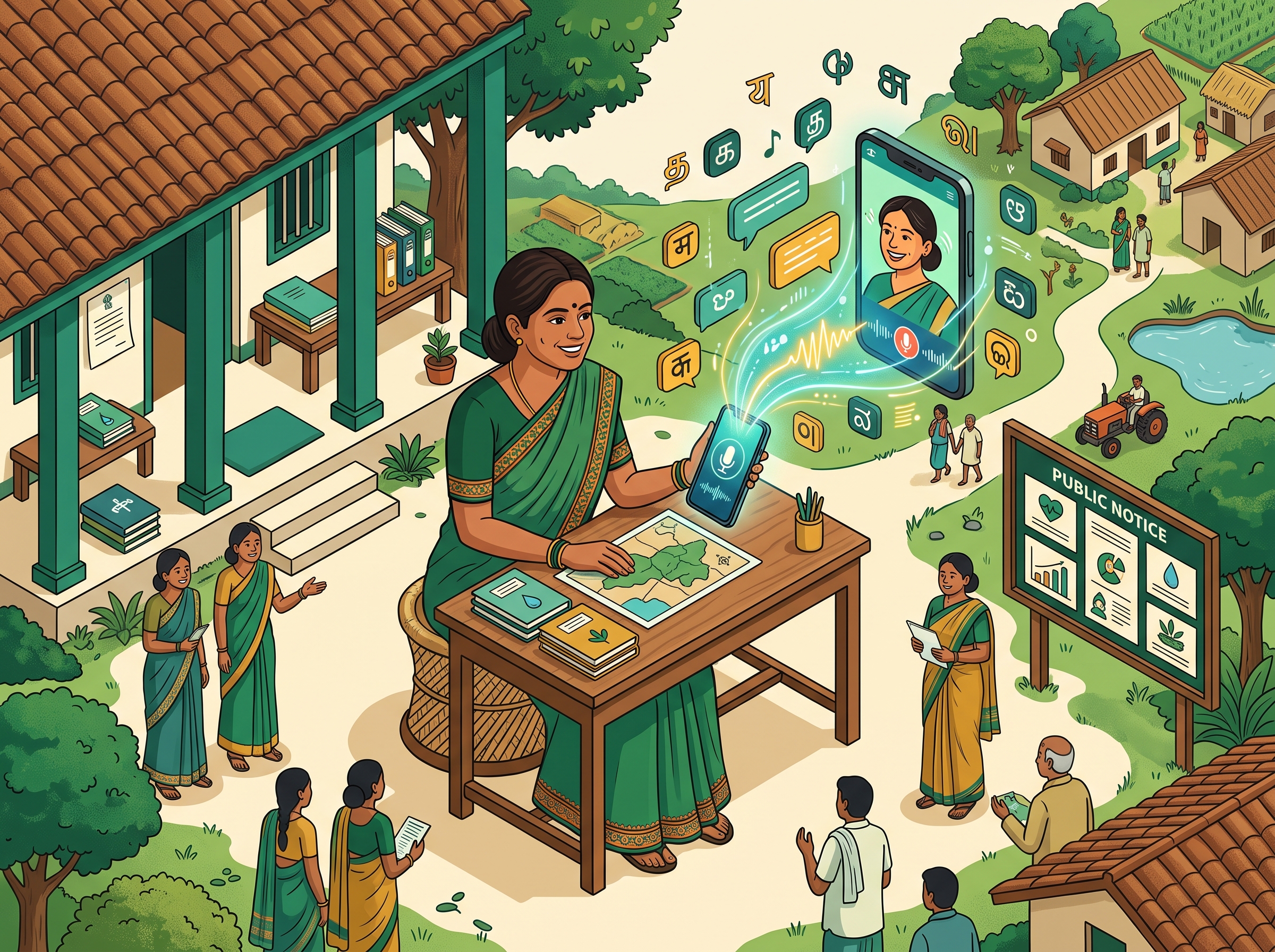
India has over 1.4 million elected women representatives in Panchayati Raj Institutions. Most face a critical information gap: they hold formal power but lack access to governance knowledge in their own language, especially in remote areas with poor connectivity. DidiSakhi is built specifically for them.
The assistant runs offline and responds to voice queries in local languages including Hindi, Gondi, Santhali, and Bundeli, using the Bhashini language stack and a locally fine-tuned Mistral 7B model with LoRA adapters. It answers questions about scheme eligibility, gram panchayat procedures, and rights, without requiring the representative to be online or literate in English.
DidiSakhi is currently in a 2-district pilot across Barwani in Madhya Pradesh and a Jharkhand district, developed in partnership with Raya.ai and BharatGen at IIT Bombay.
Offline
Works Without Internet
6+
Local Languages
2
Districts in Pilot
1.4M+
EWRs in India
728
Districts Indexed
9
RQOL Pillars
4+
Data Sources
3
Pilot Partners
CSR / Donor Decision Intelligence Platform
Data-driven district selection for CSR and philanthropic investments
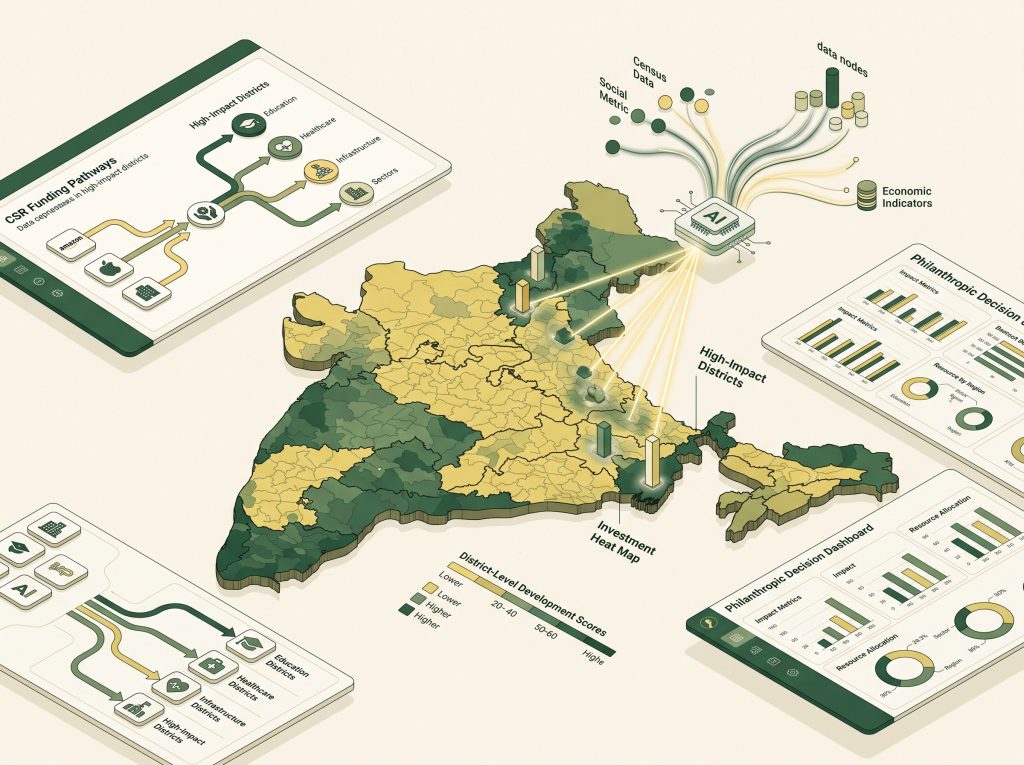
Philanthropic and CSR investments in rural India are often made on the basis of familiarity, prior presence, or anecdotal evidence rather than objective need. The result is geographic clustering of support in some districts while equally or more vulnerable districts go unserved.
The CSR / Donor Decision Intelligence Platform addresses this by providing a composite index across 728 districts, built on a 9-pillar framework drawn from the Rural Quality of Life Index. Data is sourced from NFHS-5, DISE education statistics, MCA CSR filings, and state planning datasets, giving funders a consistent, comparable view of where need is highest and where prior investment has been lowest.
The platform has been piloted with partners including Axis Bank Foundation, Tata Trusts, and Eicher Foundation, and has been presented to the Gates Foundation AI Grand Challenge.
TRAC 2.0 - The Rural Analytics Centre
1,000+ indicators. Cross-thematic analysis. District-level rural intelligence.
TRAC is DIU’s open analytics platform for district-level rural intelligence. It brings together over 1,000 indicators across 9 thematic areas, including agriculture, health, education, gender, infrastructure, governance, livelihoods, climate resilience, and social security, and enables users to analyse, benchmark, and compare performance across districts and themes in a single interface.
The platform is built for the full range of development stakeholders: government planners who need to prioritise resource allocation, researchers conducting thematic analysis, programme teams tracking outcomes, and funders assessing where to invest. TRAC 2.0 is live at trac-india.vercel.app and continues to expand its indicator set and analytical capabilities.

1,000+
Indicators
707+
Districts
9
Thematic Areas
Live
trac-india.vercel.
app